
The following is a community report on the VRMO 2026 tournament, contributed by a Singapore representative who participated.
Event Management
The overall event flow was smooth, with all timings kept on schedule throughout the weekend. The committee president demonstrated strong project management, handling exceptions promptly as they arose.
A dedicated team of staff and volunteers worked behind the scenes to support operations. After each hanchan, the referee provided timely announcements to all players covering key reminders and rulings. An observer — who was also a participating player — was available as an additional point of contact: players who were not comfortable raising concerns directly to the committee could approach the observer instead. A photographer with a professional camera was also present throughout the event.
Registration
Players who attended free play or the team event on Friday (the day before the main tournament) were able to complete registration in advance.
Two registration booths were set up, organised by last name: A–M at one booth, N–Z at the other. Each player received a set of freebies upon registration, including a pen, notebook, stickers, and a player ID card. The ID card contained the player’s tournament number, name, Discord username, tournament schedule, and a QR code linking to the VRMO site. The card was printed on high-quality plastic — comparable to the lanyards typically received at business conferences — and received positive feedback from many participants.
Logistics, Equipment, and Venue
Setup was completed on Friday evening ahead of the tournament. The event was held in a multi-purpose hall equipped with heaters. On Saturday morning, players arrived to Mahjong Soul background music and a selection of English songs.
Square tables with junk mats were used throughout, featuring 26mm tiles with yellow backing — described as similar in appearance to Donki tiles, though with slightly sharper edges. Some of the equipment was donated or loaned by staff and volunteers.
A large projector and screen displayed table pairings, tournament scores, and a countdown timer. A separate physical countdown clock on a tripod stand was positioned at the opposite end of the hall.
One automatic mahjong table — an Amos JP Color model with red tile backing, also donated or loaned — was reserved for use on the stage by the Top 4 finalists near the end of the tournament.
Below the stage, a display area showcased the tournament prizes: a total of eight items including a mahjong set, two pillows, two towels, two mugs, and a touch lamp in the shape of a large hatsu tile.
Complimentary refreshments were available throughout the event, including bottled water, coffee, tea, milk, oat milk, orange juice, and pastries (croissants and Arnott’s cookies) — a well-received option for players looking for breakfast before play began. A catered lunch was provided on Sunday afternoon, with a choice of bánh mì or rice bowls.
Player Base
An estimated 68 players participated. Based on observation, roughly half appeared to be experienced competitive players, while the other half were more casual.
The tournament used WRC lower penalties, making it accessible to a broader range of players rather than exclusively seasoned competitors. Among the players encountered during matches, a rough breakdown would be:
- 2 in 10 were casual players
- 3 in 10 played competently and won hands but struggled to declare scores independently
- 5 in 10 played well, demonstrated good etiquette, and could declare scores confidently.
On sportsmanship: experienced players generally displayed clear awareness of table etiquette, while some casual players appeared less familiar with riichi sportsmanship norms.
Tournament Format
Rules: Aka-ari, uma 30/10, lower penalties (WRC optional rules, mod 6.3).
Day 1 (5 hanchans): Pure round robin format.
Day 2 (5 hanchans): Swiss format. Players with net positive tournament scores were paired against each other; those with net negative scores were similarly grouped.
After the 8th hanchan, players who made the Top 4 cut were separated from the rest of the field and played an additional two hanchans to determine final rankings. These games were played on the automatic table on stage and were video recorded.
The referee provided structured feedback between each hanchan, covering: pace of play, correct hand scoring, the proper sequence for calling chi/pon/kan (showing the meld set first, then claiming the tile, then discarding), sportsmanship reminders, and a requirement to use English only during gameplay.
Slow play was addressed progressively. Initial announcements served as general reminders; when the issue persisted, the referee escalated to a formal warning system, with penalty points applied for repeated offences (5 points for the first, 8 points for subsequent incidents). This appeared to have a noticeable effect on game pace.
The 15-minute breaks between hanchans were sufficient for rest and toilet breaks. Players who finished a hanchan early could socialise in the adjacent waiting halls and corridors. The lunch break ran for 1 hour and 15 minutes, with the nearest food option approximately a 5-minute walk away.
Before the 8th hanchan, overall standings were displayed on the projector — particularly useful for players close to the Top 4 cut to assess how many points they needed to qualify.
Following the conclusion of all 10 hanchans, Top 4 players were asked to keep their results confidential ahead of the closing ceremony, preserving the element of surprise for the announcement.
Closing Ceremony and Award Presentation
All players gathered in front of the stage for a group photo before the closing speech began. The ceremony was video recorded.
The president gave a closing address on behalf of the committee, extending thanks to players — particularly those who had travelled from overseas or from other Australian states — as well as to all staff and volunteers.
Awards presented:
- 1st and 2nd place: Plaque
- 3rd and 4th place: Medal
- Ranks 5–8: Medal; players in this group then selected a prize from the merchandise display in descending rank order
- Ranks 9–16: VRMO pin badge
- Yakuman award: A small complimentary prize for any player who scored a yakuman during the tournament. A tenhou was recorded during the 8th hanchan; a staff member was called to document the occurrence. The moment passed quietly so as not to disrupt the hall.
- Saki award: A small complimentary prize given to the player with a final score closest to ±0. Two players were tied at +0.4; a tiebreaker was used to determine the recipient (tiebreaker method not disclosed).
Both the Yakuman and Saki awards were not announced in advance, in order to preserve the competitive atmosphere of the tournament.
Singapore Results
68 players participated in total. Results for Singapore representatives:
| Player | Final Rank | Score |
|---|---|---|
| Timothy Ling | 6th | +181.9 |
| Toh Wei Han | 18th | +77.9 |
| Adas Cheong | 51st | −73.4 |
| Ryan Tay | 63rd | −207.5 |
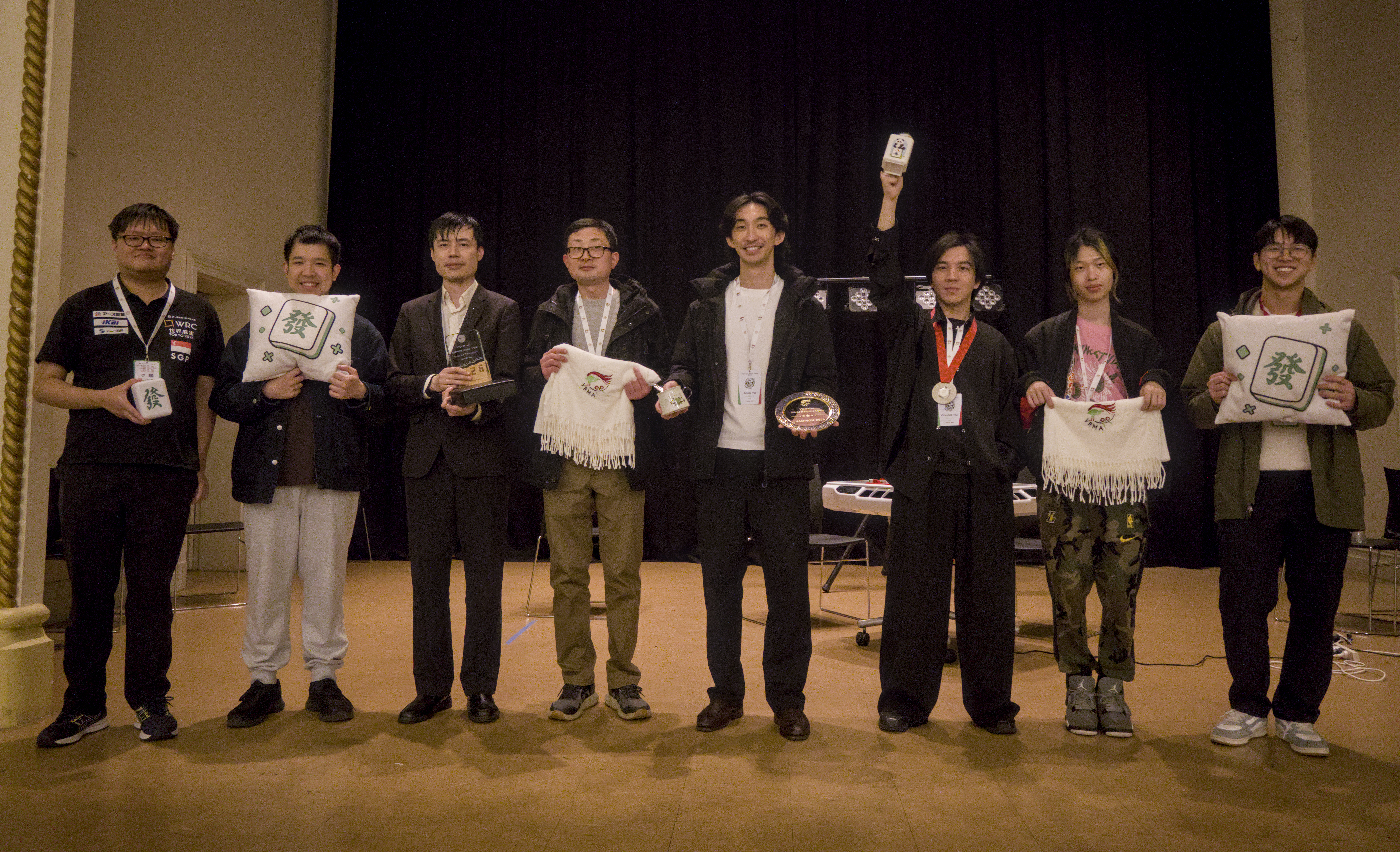
Note: Timothy (Most left) reached 5th place on the standings board at the conclusion of the 8th hanchan, coming close to making the Top 4 cut.
Final Thoughts
VRMO 2026 was a well-organised tournament pitched at an intermediate level of competition, accessible to players across a range of experience. The real strength of the event was the committee, staff, and volunteer team, whose coordination and effort behind the scenes made the weekend run smoothly.
The Victorian Riichi Mahjong Association (VRMA), established in 2024, has made a strong early impression. If this event is any indication, the association is well-positioned to continue growing the riichi community in Australia.
Overall, VRMO 2026 is recommended for Singapore players considering international tournament participation.

